
Ch.52: Tuning Random Forest on a Real Dataset
Inspired by: YouTube
Ch.51 went through random forest's hyperparameters one at a time. This one applies random forest to a real dataset end to end: a quick out-of-the-box comparison against other algorithms, cross-validation, and then two proper ways to search the hyperparameter space instead of hand-nudging one parameter at a time like Ch.51 did.
The code below follows the code-example-random-forest.ipynb notebook from the course's repo, using its heart.csv dataset (303 patients, several clinical measurements, a binary heart-disease label).
1. Out of the Box, Random Forest Is Already Competitive
Load the data, split it, and fit a plain RandomForestClassifier alongside gradient boosting, an SVC, and logistic regression, all with default settings, no tuning:
import pandas as pd
from sklearn.model_selection import train_test_split
from sklearn.ensemble import RandomForestClassifier, GradientBoostingClassifier
from sklearn.svm import SVC
from sklearn.linear_model import LogisticRegression
from sklearn.metrics import accuracy_score

df = pd.read_csv('heart.csv')
X, y = df.iloc[:, 0:-1], df.iloc[:, -1]
X_train, X_test, y_train, y_test = train_test_split(X, y, test_size=0.2, random_state=42)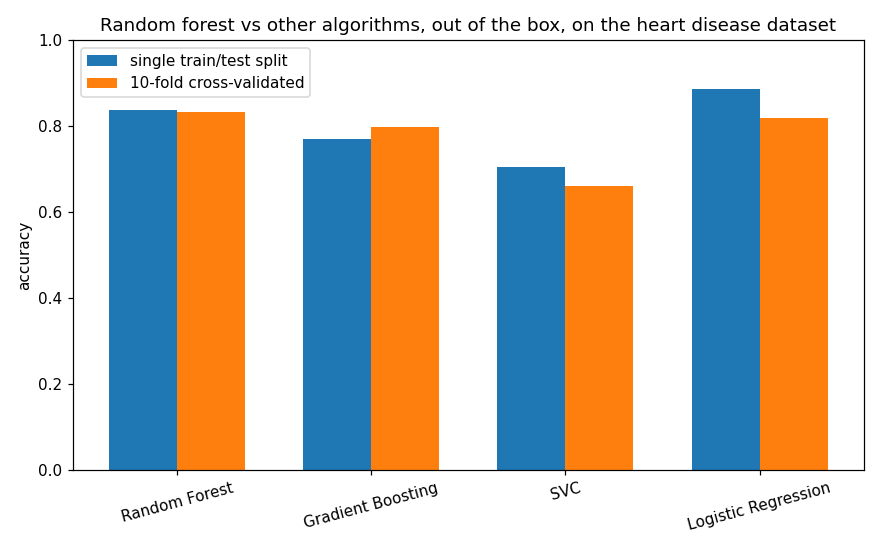
On a single train/test split, logistic regression edges out random forest here (0.89 vs 0.84), a sign this particular dataset has a fairly linear relationship between features and outcome. But single-split accuracy is noisy, it depends on which 20% happened to land in the test set. Averaging over 10-fold cross-validation instead, logistic regression drops to 0.82 while random forest holds at 0.83, essentially a tie between the two, with gradient boosting close behind and SVC clearly behind both. This is the actual claim worth taking from this section: random forest doesn't need to win outright to be worth reaching for by default, it consistently lands in the top 2-3 algorithms on a tabular problem without any tuning at all, which is not true of most algorithms out of the box.
2. A Single Hand-Picked Parameter Already Helps a Little
Before reaching for a systematic search, trying one educated guess shows tuning has room to help: setting max_samples=0.75 (the sweet spot Ch.51 found) nudges the cross-validated score from 0.832 to 0.835, a small but real gain from one parameter. With more parameters to adjust simultaneously, and no way to know in advance which combination of values works best together, guessing one at a time stops being practical. That's the problem the next two tools solve.
3. GridSearchCV: Try Every Combination
GridSearchCV takes a dictionary of parameter values and trains a model for every possible combination of them, evaluating each with cross-validation:
from sklearn.model_selection import GridSearchCV

param_grid = {
    'n_estimators': [20, 60, 100, 120],
    'max_features': [0.2, 0.6, 1.0],
    'max_depth': [2, 8, None],
    'max_samples': [0.5, 0.75, 1.0],
}
# 4 x 3 x 3 x 3 = 108 combinations

rf = RandomForestClassifier(random_state=42)
rf_grid = GridSearchCV(estimator=rf, param_grid=param_grid, cv=5, n_jobs=-1)
rf_grid.fit(X_train, y_train)
4 values times 3 times 3 times 3 is 108 distinct combinations, "grid" because you can picture it as a 4-dimensional table with one random forest trained per cell. At cv=5, that's 108 x 5 = 540 individual model fits for one call. Reading off the winner:
best params: {'max_depth': 8, 'max_features': 0.2, 'max_samples': 0.75, 'n_estimators': 20}
best score: 0.839
max_features=0.2, max_samples=0.75, and n_estimators=20 match the values traced by hand in Ch.51. max_depth=8 came out best in this run rather than unlimited depth, a difference worth flagging honestly: the search itself is exhaustive and reproducible given a fixed random_state, but the winning combination depends on the exact random forest runs and data split, so don't expect to reproduce the video's exact numbers digit for digit, only the same shape of result, a small, real improvement over the untuned default.
4. RandomizedSearchCV: Sample Instead of Enumerate
Add a few more parameters to search (bootstrap, min_samples_split, min_samples_leaf) and the grid balloons to 864 combinations. GridSearchCV would train all 864 x 5 folds worth of models, exhaustive but slow. RandomizedSearchCV instead draws a fixed number of random combinations from the same space and only trains those:
from sklearn.model_selection import RandomizedSearchCV

param_grid = {
    'n_estimators': [20, 60, 100, 120],
    'max_features': [0.2, 0.6, 1.0],
    'max_depth': [2, 8, None],
    'max_samples': [0.5, 0.75, 1.0],
    'bootstrap': [True, False],
    'min_samples_split': [2, 5],
    'min_samples_leaf': [1, 2],
}
# 4 x 3 x 3 x 3 x 2 x 2 x 2 = 864 combinations

rf_rand = RandomizedSearchCV(estimator=rf, param_distributions=param_grid,
                              n_iter=10, cv=5, n_jobs=-1, random_state=42)
rf_rand.fit(X_train, y_train)
n_iter=10 samples only 10 of the 864 combinations rather than all of them, 10 x 5 = 50 fits instead of 4,320. The result:
best score: 0.822
Lower than GridSearchCV's 0.839, which is expected: sampling 10 out of 864 combinations can miss the actual best one, and did here. The trade being made is speed for optimality, not speed for nothing.
5. When to Use Which
- Small dataset, few hyperparameters to search:
GridSearchCV. It's exhaustive, so it finds the true best combination in the grid you defined, and on a small search space the cost is manageable (540 fits ran quickly here on 242 training rows). - Large dataset, or many hyperparameters (a large combination space):
RandomizedSearchCV. An exhaustive search over thousands of combinations on a large dataset can take an impractical amount of time; sampling a few dozen combinations gets you a near-optimal result in a fraction of the time.
Neither tool is universally better, they trade completeness for speed in opposite directions, and the right choice depends on how big the search space and the dataset both are.
6. A Free Validation Set: the OOB Score
Every tree in a random forest is trained on a bootstrap sample, rows drawn with replacement from the training set (Ch.45, Ch.48). Because the draw is with replacement, some rows get picked more than once for a given tree, and, just as importantly, some rows never get picked at all for that tree. Mathematically, roughly 37% of the training rows are left out of any single tree's bootstrap sample, the out-of-bag (OOB) samples for that tree.
Those rows were never seen by that particular tree, but they're still real labeled data. RandomForestClassifier(oob_score=True) uses them as a built-in validation set: for each row, it predicts using only the trees that never saw that row during training, then compares those predictions against the true labels. That gives you a validation estimate without setting aside a separate validation split at all, the "free" part.
from sklearn.ensemble import RandomForestClassifier
from sklearn.metrics import accuracy_score

rf = RandomForestClassifier(oob_score=True, random_state=42)
rf.fit(X_train, y_train)
print(rf.oob_score_)

y_pred = rf.predict(X_test)
print(accuracy_score(y_test, y_pred))
On the same heart disease dataset used above:
oob_score_: 0.822
test accuracy: 0.836
The OOB score (0.822) lands close to the real held-out test accuracy (0.836), close enough to trust as a rough estimate of how the model generalizes, without touching the test set at all. It's not a replacement for a proper train/test split or cross-validation when you need a precise number, but it's a useful free sanity check, especially on small datasets like this one where every row held back for a separate validation set is a row the model doesn't get to train on.
7. What to Take Away
- Random forest performs competitively out of the box, without tuning, against algorithms that need more care to get right; on this dataset it tied logistic regression under cross-validation and beat gradient boosting and SVC.
- Hand-tuning one hyperparameter at a time (Ch.51's approach) can help, but doesn't scale once you have several hyperparameters that interact with each other.
GridSearchCVsearches a hyperparameter grid exhaustively, guaranteed to find the best combination within that grid at the cost of training every combination.RandomizedSearchCVsamples a fixed number of combinations instead, trading a chance of missing the true optimum for dramatically less compute, the right call on large search spaces or large datasets.- Bootstrap sampling leaves roughly 37% of each tree's training rows unseen by that tree;
oob_score=Trueuses those leftover rows as a free, built-in validation estimate.
Next: how random forest calculates feature importance, and how it's calculated for a single decision tree in the first place.